
Lathe Machine: Guide To Turning Operations, Tools, And Cutting Parameters

Lathe machines are machine tools that rotate a workpiece about its axis while a cutting tool removes material to produce cylindrical or conical shapes. Operators set up a blank between a headstock and tailstock or secure it in a chuck, then control relative motion between tool and workpiece to perform turning, facing, boring, and grooving. The process relies on predictable material removal, where geometry of the cutting tool, the rigidity of the setup, and the selected cutting parameters together determine surface finish, dimensional accuracy, and cycle time.
The mechanical and operational principles include spindle speed, feed rate, and depth of cut as primary variables that influence metal removal rate and tool wear. Cutting tool materials and angles may be chosen to suit the workpiece material and intended operation. Workholding method and machine rigidity can affect vibration and concentricity. Heat generation and chip evacuation are managed by coolant, cutting speed adjustments, and tool geometry considerations to maintain consistent machining conditions and part tolerance.
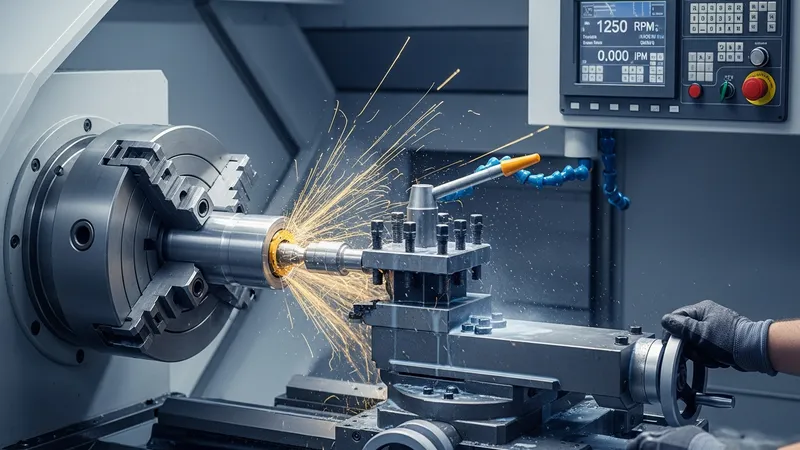
- Conventional engine lathe — A manually or semi-automatically controlled machine common in general-purpose workshops; typically used for single-piece setups, prototype work, and repair tasks where operator adjustments are frequent.
- CNC lathe — Numerically controlled turning centers that automate tool paths and feed rates; often used for repeatable production work and complex profiles that require precise, programmable tool motion.
- Turret lathe — A lathe with a rotating turret holding multiple tools for sequential operations; typically used in medium-volume production where several different turning operations are performed without frequent tool changeovers.
Conventional engine lathes may offer a wide range of manual control and fixturing flexibility, which can be advantageous for one-off parts and learning turning fundamentals. They can require skilled setup to achieve repeatable results and may rely more on operator judgement for feeds and speeds. For certain materials, operators may often select conservative cutting parameters to reduce chatter and extend tool life. Typical workshop practice includes verifying spindle runout and ensuring secure clamping before machining to reduce dimensional error.
CNC lathes can typically maintain tighter tolerances through programmed compensation and automated tool changes, which may reduce cycle variation across batches. They often support multiple cutting tools and live tooling for milling features on turned parts. Programming may consider tool life cycles and tool offsets; monitoring parameters such as cutting temperature and tool wear can inform adaptive adjustments. CNC setups commonly use preset tooling and probe cycles to improve first-piece inspection and reduce setup time compared with purely manual methods.
Turret lathes may reduce non-cutting time by keeping several tools mounted and indexed rapidly, which can be useful in workflows that repeat a sequence of turning, facing, and parting operations. Tool turret indexing speed and turret capacity typically influence throughput. Tool geometry selection for turret operations often favors robustness to handle interrupted cuts and maintain tool life across repeated cycles. Operators may plan turret layouts to sequence tools in a way that minimizes retraction and travel between operations.
Cutting parameters—spindle speed, feed, and depth of cut—interact nonlinearly and typically require balancing for desired surface finish and tool life. Higher cutting speeds may increase productivity but can accelerate wear depending on material and tool grade. Feed affects surface roughness and chip load per tooth on multi-point tools, while depth of cut determines material removal per pass. Machining plans often document parameter ranges that may be empirically adjusted during initial trials to account for specific material batches, tool condition, and machine rigidity.
Control of tool geometry and material choices can influence chip formation and heat distribution during turning. Positive rake angles may reduce cutting forces for ductile materials, while negative rake may be chosen for interrupted cuts or hard materials to strengthen the cutting edge. Coated carbide grades often extend tool life in higher-speed applications, whereas high-speed steel tools may be preferred for low-volume or manual work where toughness and ease of grinding are useful. Tool holding stiffness and proper insert clamping can also reduce vibration and improve surface integrity.
In summary, understanding machine type, typical turning operations, cutting parameters, tool geometry, and workholding methods forms the foundation for consistent lathe machining. Each element may influence the others: machine rigidity can affect achievable cutting speeds, and tool choice can dictate feed rates that maintain acceptable surface finish. The next sections examine practical components and considerations in more detail.