
SaaS Security Posture Management: How It Helps Organizations Monitor And Reduce SaaS Risk

A focused practice for managing security across cloud-hosted business applications involves continuous assessment of configuration, identity, and access settings to maintain an acceptable security posture. This discipline collects telemetry from multiple software-as-a-service platforms, evaluates settings against policy baselines, and presents findings as prioritized issues. The aim is to increase situational awareness about where applications may expose data, where controls are weak, and where administrative settings diverge from organizational rules, so teams can address the most consequential gaps first.
Operationally, this approach typically combines automated scanners, connectors to SaaS APIs, and analytics that surface deviations from expected configurations. It often incorporates identity signals such as privileged account activity, third-party integrations, and service-to-service credentials. Outputs frequently include a risk register or dashboard that groups findings by severity, affected application, and suggested remediation paths. The process may also feed into compliance workflows to demonstrate continued adherence to internal or external standards.
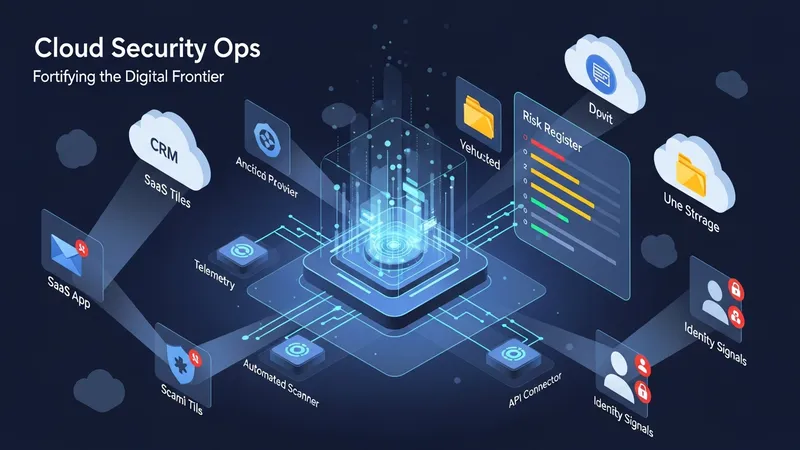
- Continuous monitoring platforms — automated connectors that poll SaaS APIs and event streams to detect configuration drift and anomalous activity; these tools typically focus on visibility and alerting rather than manual audits.
- Configuration assessment tools — scanners that compare application settings against security benchmarks and policy templates to identify misconfigurations, excessive permissions, or unapproved sharing settings.
- Identity and access governance methods — processes and tools that evaluate account privileges, orphaned accounts, and third-party app authorizations to reduce excessive access and to track entitlement changes over time.
Continuous monitoring may provide near-real-time visibility into application changes and usage patterns that static audits miss. In many environments, frequent API polling and event-driven ingestion can reveal newly created integrations, altered sharing policies, or sudden increases in data access by external collaborators. These signals can be correlated with known risk indicators — for example, newly provisioned service accounts or scope expansions on delegated OAuth tokens — to prioritize investigation. Monitoring outputs often feed ticketing or incident response systems so that remediation can follow established operational procedures.
Configuration assessment typically focuses on settings that commonly expose data or weaken control, such as public file sharing, broad administrative roles, or disabled security features. Automated assessments often apply a baseline or policy template and then score deviations to help teams triage. Because many SaaS platforms offer different configuration surfaces, assessment tools may standardize findings into common categories (access control, data handling, integrations) so that security teams can compare posture across disparate applications without requiring deep product-by-product expertise.
Identity and access governance workstreams usually examine who has access, how access is granted, and what integrations have been authorized. Reviews may reveal stale accounts, excessive group memberships, or third-party apps with broad scopes that were granted long-lived tokens. These findings can be framed as entitlement risk and prioritized by the sensitivity of the data or the role’s level of privilege. Governance approaches often combine periodic reviews with automated alerts when high-risk changes occur.
Compliance monitoring and policy enforcement link posture findings to regulatory or organizational requirements by mapping misconfigurations and identity risks to specific controls. Reports may show control status over time and help build evidence for audits. Because compliance frameworks vary, many teams select a limited set of rules to monitor continuously and leave less critical checks to scheduled reviews. This layered approach can reduce the time auditors spend validating routine controls while keeping attention on changes that materially affect compliance posture.
In summary, the practice centers on continuous visibility, assessment, and governance of cloud-hosted application settings and identities so that organizations can detect, triage, and remediate SaaS-related risks more efficiently. The examples listed above illustrate common tool and method categories often used together to create an operational posture program. The next sections examine practical components and considerations in more detail.