
AI Research Technologies: Exploring Data Pipelines, Training Workflows, And Deployment

AI research technologies that cover data pipelines, training workflows, and deployment describe the systematic processes used to turn raw data into trained models and then operate those models in experiments or production-like settings. The concept includes ingesting and validating data, transforming and versioning datasets, defining and executing training procedures, tracking experiments, evaluating model behavior, and packaging models for deployment. Each stage interacts with infrastructure and tooling choices that can affect reproducibility, resource use, and the ability to compare alternatives. Describing the concept requires attention to both the technical steps and the practices that support rigorous research workflows.
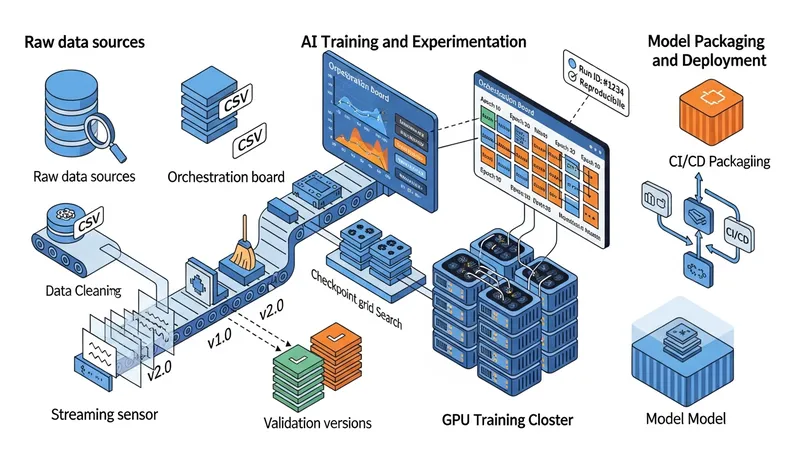
Within this framework, data pipelines refer to the automated sequences that collect, clean, and prepare data for modeling; training workflows denote the orchestration of model optimization, hyperparameter exploration, and checkpointing; deployment covers packaging, serving, and monitoring of models. Research-oriented implementations often emphasize traceability and experiment metadata so that outputs can be reproduced or audited. Tooling choices may vary by project scale and objectives, and typical workflows can interoperate with experiment tracking systems, continuous integration for models, and container-based runtime environments.
- Apache Airflow — orchestration tool commonly used to schedule and manage data ingestion and transformation tasks in pipeline workflows, with support for dependencies and retry logic.
- PyTorch — a training framework often used in research for model definition, gradient-based optimization, and flexible experimentation with dynamic computation graphs.
- Kubernetes — container orchestration platform frequently used to deploy models at scale, manage replicas, and integrate load balancing and service discovery.
These examples were selected as representative tools often referenced in research settings: one focused on pipeline orchestration, one on model training, and one on deployment orchestration. Descriptions are neutral and intended to show how different components can align in a research lifecycle. In practice, a team may combine an orchestration tool like Apache Airflow to produce datasets that feed into training runs implemented with frameworks such as PyTorch; trained artifacts may then be containerized and scheduled using systems like Kubernetes. The rest of this page expands on interactions among these example components.
Data orchestration tools such as Airflow may handle periodic ingestion, data quality checks, and triggering of downstream training workflows. When pipelines include schema validation and lineage capture, researchers can more readily trace model inputs back to raw sources and transformations. Using pipeline operators to emit metadata or artifacts into an experiment tracking system can simplify comparisons between model versions. Considerations often include how to store intermediate datasets, how to version transformation logic, and how to balance automation with manual inspection during exploratory stages.
Training frameworks like PyTorch frequently provide mechanisms for checkpointing, mixed-precision training, and distributed execution that can be integrated into research workflows. Researchers often use experiment tracking tools to record hyperparameters, random seeds, and metrics so that runs are comparable. Distributed training setups may reduce iteration time but add complexity in debugging and reproducibility; for example, synchronization of random states and consistent data sharding are typical concerns. Integrations between training code and pipeline orchestration can help automate full retraining when upstream data changes.
Deployment orchestration platforms such as Kubernetes may be used to standardize runtime environments for model serving, enabling researchers to test models under production-like constraints. Container images can encapsulate runtime dependencies and model artifacts, and service meshes or ingress controllers may manage traffic for evaluation scenarios. Monitoring and logging during deployment can capture performance and behavior drift over time; in research contexts, such telemetry may be used to inform further experiments rather than drive live corrective actions. Packaging decisions often consider reproducibility, resource limits, and experiment isolation.
Combining these components often involves trade-offs: greater automation can improve throughput but may require more engineering effort to ensure reproducibility; lightweight, ad hoc scripts may be quicker for exploration but harder to scale or audit. Researchers commonly design modular workflows where pipelines, training loops, and deployment artifacts are versioned and linked through metadata. This modularity can facilitate iterative cycles and allow teams to replace or upgrade individual components without reworking entire workflows. The next sections examine practical components and considerations in more detail.