
AI Research Technologies: Exploring Data Pipelines, Training Workflows, And Deployment

Data pipelines and ingestion aspects in AI research technologies: Exploring Data Pipelines, Training Workflows, and Deployment
Data ingestion and pipeline design form the foundation for experimental rigor. In research contexts, pipelines may include steps for raw data capture, de-duplication, schema enforcement, anonymization, and sampling strategies. Typical pipelines may emit standardized dataset artifacts along with metadata such as provenance, processing timestamps, and checksums. Researchers often consider storage formats (for example, columnar formats for analytical workloads) and access patterns when designing pipelines. Practical considerations may include trade-offs between storing multiple processed versions for speed versus computing transforms on the fly to save storage.
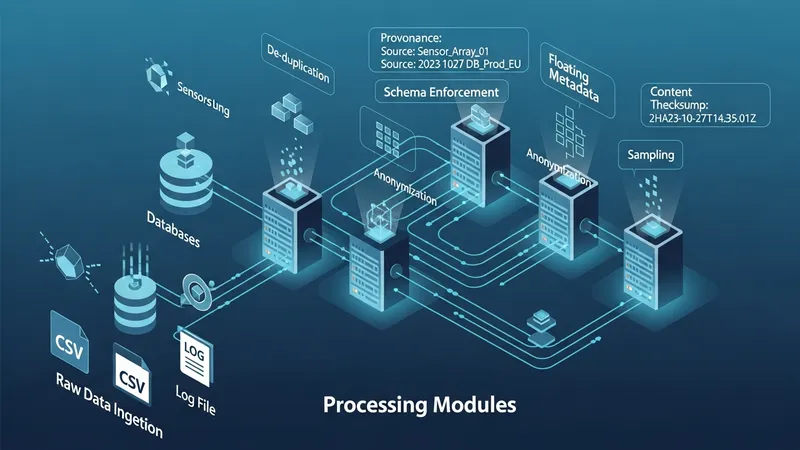
Versioning datasets can often improve reproducibility by enabling exact reconstitution of inputs used for a specific training run. Tools and conventions may support dataset snapshots, content-addressed storage, or manifest files that list constituent files and their checksums. Researchers may also track dataset lineage so that model results can be traced back to upstream sources and transformations. When pipelines include synthetic data generation or augmentation, documenting configuration and random seeds often helps other researchers interpret experimental outcomes.
Pipeline orchestration choices may affect how easily data flows into training workflows. Apache Airflow and similar systems often provide scheduling, retries, and dependency management, which can be useful when pipelines must coordinate across systems (databases, object stores, message queues). Researchers may use lightweight task runners during prototyping and switch to more robust orchestration for larger experiments. Tips as considerations include adopting clear naming conventions for pipeline tasks, centralizing configuration, and emitting structured logs to ease debugging when failures occur.
Data validation and quality checks are commonly integrated into pipelines to detect distributional shifts, missing values, or schema violations before training. Automated checks can prevent wasted compute on training runs that use corrupted inputs. Researchers typically balance the depth of validation with iteration speed: simple checks may catch obvious issues early, while more complex validations can run periodically or as part of gating before major experiments. These choices often reflect resource constraints and the desired level of assurance in experimental results.