AI Research Technologies: Exploring Data Pipelines, Training Workflows, And Deployment

Model training workflows and experiment tracking in AI research technologies: Exploring Data Pipelines, Training Workflows, and Deployment
Training workflows encapsulate the sequence of steps that move from dataset artifacts to trained model checkpoints and evaluation metrics. Core elements typically include data loading and augmentation, model initialization, optimization loops, checkpointing, and metric logging. Research-oriented workflows may incorporate hyperparameter sweeps, ablation studies, and controlled variations to probe behavior. Integration with experiment tracking systems allows recording of configurations, seed values, and metric trajectories so that researchers can compare runs and reproduce selected experiments with the same settings.
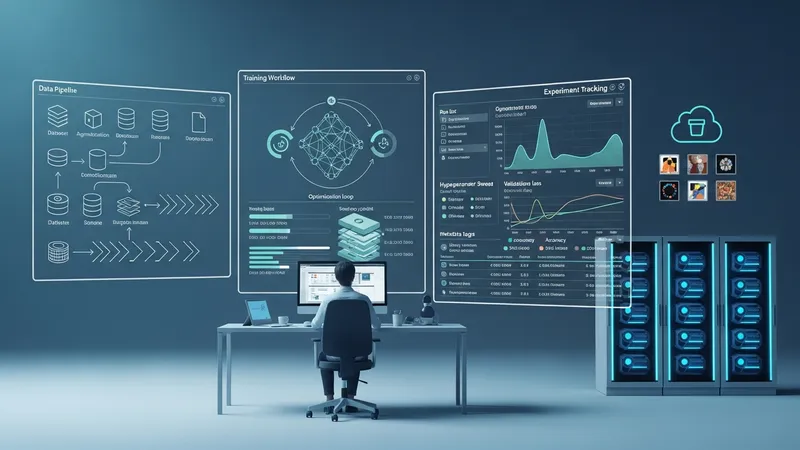
Experiment tracking tools often capture metadata about the training environment such as library versions, hardware configuration, and elapsed wall time. This contextual information can be important when results are sensitive to software or hardware differences. Researchers may store artifacts like model weights, evaluation outputs, and sample predictions together with run metadata. Typical considerations include the storage cost of frequent checkpoints, how to retain only the most informative artifacts, and how to index runs for later analysis.
Distributed training techniques may speed up iteration but introduce challenges in determinism and debugging. Common approaches include data-parallel and model-parallel strategies; their applicability often depends on model size and hardware availability. When using distributed execution, researchers often pay attention to reproducible initialization, consistent batching, and the handling of non-deterministic operations. Practical tips presented as considerations include validating single-node behavior thoroughly before scaling and documenting communication strategies used for synchronization.
Linking training workflows to upstream data pipelines and downstream deployment artifacts is useful for lifecycle management. For instance, pipeline triggers can initiate retraining when new data meets certain criteria, and tracked experiment artifacts can be used to build container images for testing in staging environments. Researchers often outline interfaces between components so that changes in one area (e.g., a new preprocessing step) are reflected in recorded experiment metadata. These interfaces can simplify replication of experiments and reduce hidden dependencies.