Employee Monitoring Software: Key Features, Functions, And Use Cases

Employee monitoring software refers to a class of administrative tools that collect and present data about how digital workplace resources are used. These systems typically record time spent on tasks, application and website use, attendance and clock-in events, and activity logs generated by endpoints or cloud services. The aggregated data is then displayed through dashboards and reports to support operational oversight, resource planning, and policy compliance. The concept focuses on observable workplace actions rather than personal or medical information, and implementations can vary according to organizational scale and technical environment.
Implementations of employee monitoring software often combine several functions in a single suite or as integrated modules. Core functions commonly include automated time tracking, screenshot or activity sampling, application and website categorization, keystroke or idle detection for productivity context, and configurable reporting. Administrative features may include role-based access to data, data retention settings, and exportable reports for auditors or managers. Such tools may be deployed on desktops, mobile devices, virtual desktops, or via network-level monitoring depending on organizational needs and infrastructure.
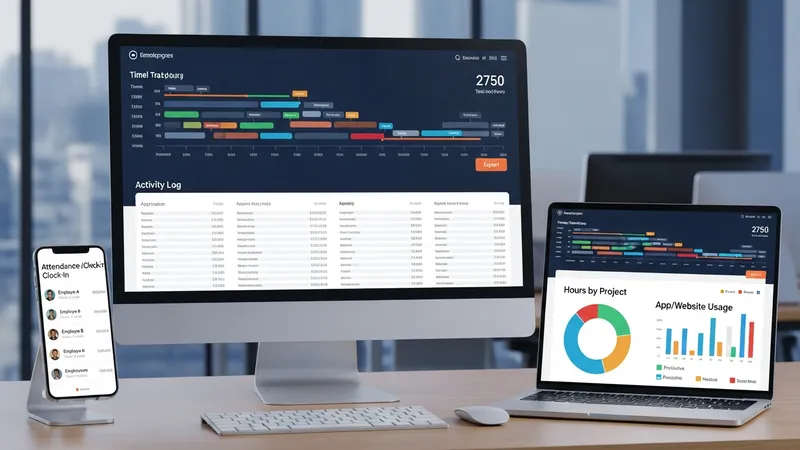
- Time-tracking and activity logging — automated or manual capture of work sessions and timestamps, useful for attendance reconciliation and duration analysis.
- Application and website usage monitoring — categorization of active applications and visited domains to support productivity analysis and policy controls.
- Policy compliance and reporting modules — dashboards, alerts, and exportable reports to help demonstrate adherence to internal or external standards.
Time-tracking and activity logging may record active application focus, window titles, and elapsed session time to create a timeline of work. These records can be coarse-grained (session-level totals) or fine-grained (detailed timestamps and interaction metrics). The level of granularity often depends on configuration choices and legal or policy constraints; organizations commonly balance the desire for operational detail against privacy and storage considerations. Integration with payroll or scheduling systems is a frequent administrative use case, though such integrations typically require planning around data formats and retention policies.
Application and website usage monitoring often relies on categorization frameworks that map application names or URLs to functional groups such as “communication,” “development,” or “entertainment.” These categorizations may be predefined or customizable, and they can support aggregated reporting across teams or departments. Data from app/website monitoring can be used for capacity planning, identifying training needs, and understanding tool adoption patterns. However, analysts often treat such metrics as indicators rather than definitive measures of individual performance.
Productivity reporting and dashboards commonly present several derived metrics such as active time, idle time, focus intervals, and most-used tools. Visualizations may include timelines, heat maps, and distribution charts that surface usage patterns over days or weeks. These outputs typically inform operational decisions like staffing, shift planning, and software licensing allocation. It is common for organizations to pair quantitative monitoring outputs with qualitative inputs, such as manager observations or employee self-reports, to produce a more complete contextual picture.
Attendance monitoring and schedule reconciliation features can provide automated clock-in/out, break tracking, and exception reporting for absences or late starts. These modules often support configurable thresholds and alerts so administrators can identify anomalies without constant manual review. When combined with access control or badge systems, attendance data may be cross-referenced to verify physical presence where relevant. Such combinations may be helpful for compliance with labor regulations when organizations configure policies in line with applicable rules.
In summary, employee monitoring software encompasses a set of functions that may include time tracking, application and website monitoring, reporting dashboards, and compliance-oriented features. Organizations often adopt combinations of these capabilities to address operational oversight, resource planning, and regulatory needs while considering privacy, transparency, and technical constraints. The next sections examine practical components and considerations in more detail.