
Privileged Account Management Software: How It Supports Access Security And Compliance

Privileged account management software: technical components and integrations
Core technical components commonly found in these systems include a secrets store, a session broker, connectors for directory services, and APIs for automation. The secrets store secures credentials and may support encryption at rest and in transit. Session brokers can proxy protocols like SSH and RDP to capture activity. Directory connectors allow synchronization of user and group data so policies can be applied consistently across resources. APIs enable integration with orchestration tools and cloud providers, which may be necessary in environments that rely on automated provisioning.
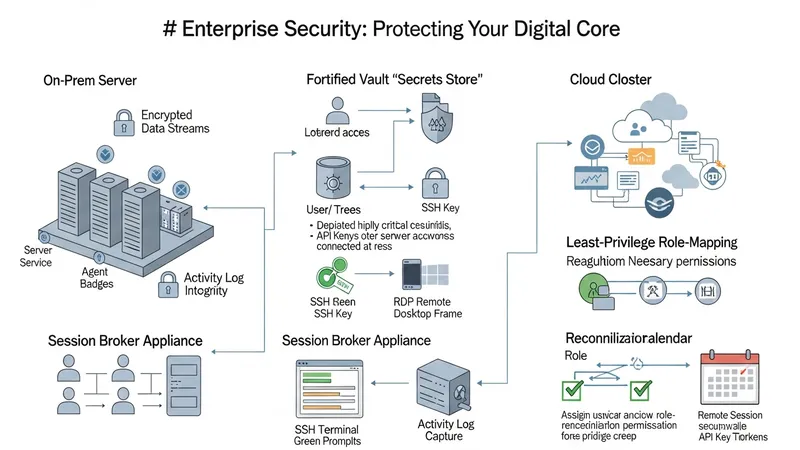
Integration patterns often depend on existing infrastructure: on‑premises environments may use agent‑based connectors, while cloud resources may rely on identity federation and temporary API keys. Where possible, organizations typically aim for least‑privilege mappings between directory roles and privileged roles; this requires careful role design and periodic reconciliation. Automation can reduce human error but may introduce complexity if connectors are not maintained or if API permissions are overly broad.
Encryption and key management are foundational considerations. Secrets stored in a vault may be encrypted using keys managed by an external key management system (KMS) or by the product itself. Access to encryption keys should be limited and auditable to prevent unauthorized retrieval of large sets of credentials. Operational practices such as key rotation schedules and split knowledge controls may be applied to reduce single points of failure.
Scalability and availability planning are also relevant technical concerns. In larger environments, the secrets store and session proxy may need clustering, load balancing, and geographic redundancy. Latency introduced by proxies can affect user workflows, so performance testing and staged rollouts are often recommended as considerations rather than directives. Continued reading explores procedural and compliance aspects that complement these technical elements.