
SaaS Security Posture Management: Core Capabilities And Security Controls Explained

Organizations use a focused approach to assess and manage the security of cloud-hosted business applications and the policies that govern them. This approach collects configuration data, identity and access settings, and activity telemetry from multiple SaaS services to build a consistent view of risk and control posture. The process typically spans discovery of authorized and unauthorized applications, mapping of configuration settings against policy baselines, and the generation of prioritized findings that security teams can interpret. The emphasis is on continuous visibility into settings and relationships that may introduce exposure in a SaaS environment.
At its core, this discipline organizes controls and assessments to reduce configuration drift, detect misapplied privileges, and supply evidence for regulatory or internal compliance checks. Automation often plays a role in collecting APIs, scanning tenant and application settings, and correlating events across identity providers and service consoles. Outputs commonly include alerts about risky configurations, dashboards showing aggregate posture trends, and guidance that aligns observed states to organizational policy statements or compliance frameworks. The approach is frequently integrated with broader cloud or identity security operations to inform remediation planning.
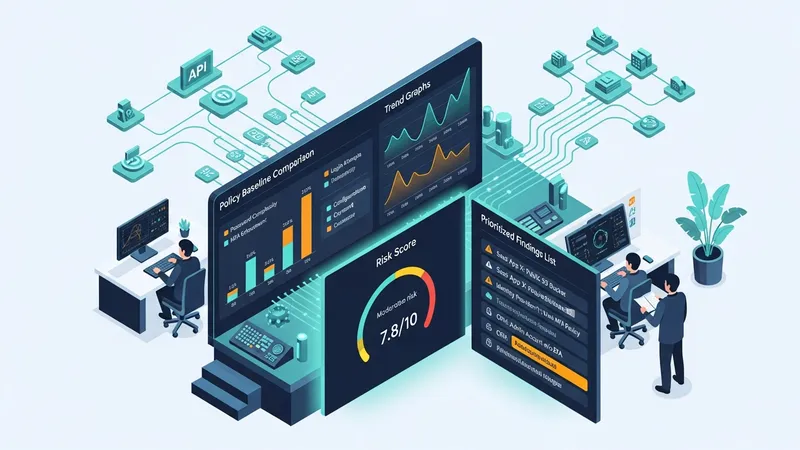
- Configuration monitoring and misconfiguration detection — automated scans of SaaS tenant settings to identify deviations from acceptable baselines and common hardening recommendations.
- Identity and access governance methods — analysis of user roles, privileges, single sign-on mappings, and orphaned accounts to identify excessive access and privilege creep.
- Continuous compliance assessment and reporting — ongoing checks against regulatory or internal frameworks that produce evidence artifacts and trend metrics for audits.
Configuration monitoring may cover items such as external sharing settings, API token scopes, session timeout policies, and application integrations. These scans often map observed values to a set of desired baselines which can be derived from vendor guidance, industry frameworks, or organizational standards. The mapping process typically includes severity assignment and a contextual description so that teams can prioritize corrections. In many implementations, integrations with ticketing or orchestration systems allow findings to be tracked and remediated with human review, reducing operational friction while preserving audit trails.
Identity and access governance functions look at user and service identities across connected SaaS platforms. Common checks include detection of multi-factor authentication gaps, excessive administrative roles, stale accounts, and unconstrained third-party access. Analysis sometimes extends to service principals and OAuth apps that may hold long-lived credentials. Because identity-related exposures can enable lateral movement or unauthorized data access, correlating identity findings with configuration issues often reveals higher-impact risks that warrant expedited attention by security teams.
Compliance assessment in this context often involves translating control statements from standards into verifiable checks against SaaS artifacts. For example, a requirement for least privilege can be operationalized by verifying that privileged roles are limited and that just-in-time mechanisms are used where available. Reporting functions aim to produce evidence that can be included in internal audits or external reviews, and may capture timestamps, API responses, and remediation status. Such reporting can help organizations track posture over time and demonstrate progress on control objectives.
Continuous monitoring and alerting provide the ongoing detection capability needed to respond to configuration drift and emergent exposures. Telemetry sources typically include SaaS provider APIs, identity provider logs, and cloud access security broker feeds. Correlation of events across these feeds can surface compound issues, for example when a configuration change coincides with a credential compromise. While automation may surface likely remediations, many organizations maintain human validation steps to reduce false positives and to ensure changes align with business needs.
In summary, this discipline brings together configuration visibility, identity governance, compliance mapping, and continuous monitoring to create an operationally useful picture of SaaS control health. It is oriented toward reducing misconfigurations, limiting excessive access, and supplying auditable evidence for controls. Adoption often proceeds incrementally, beginning with discovery and a small set of high-risk checks before expanding coverage. The next sections examine practical components and considerations in more detail.