
SaaS Security Posture Management: Core Capabilities And Security Controls Explained

Identity and access control practices within SaaS posture management
Identity-centric checks focus on the relationship between user accounts, roles, and external integrations. Evaluations commonly include verification of single sign-on configurations, enforcement of multi-factor authentication policies, and identification of privileged roles and service accounts. Effective implementations often correlate identity data with activity logs to detect unusual privilege use patterns. As organizations scale the number of SaaS services, centralizing identity governance through role definitions and lifecycle processes can reduce privilege creep and simplify ongoing posture assessments.
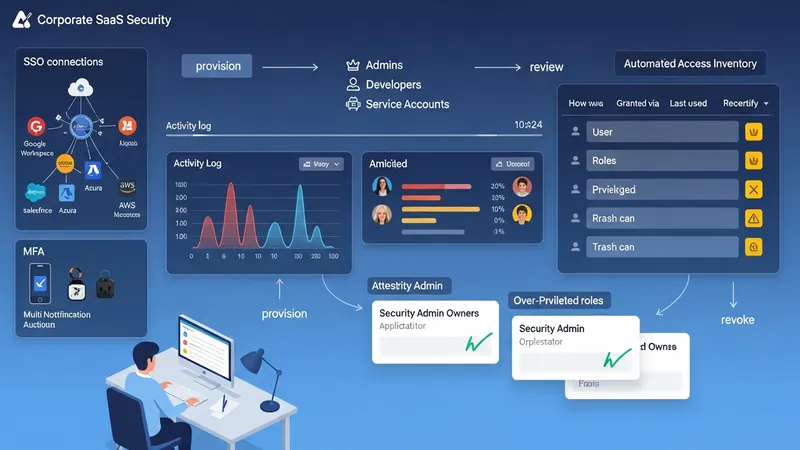
Access review processes may be supported by automated inventories that list who has access to what, how access was granted, and when it was last used. These inventories can facilitate periodic recertification cycles, orphaned account removal, and identification of over-privileged roles. In many cases, organizations combine technical controls with attestations from application owners to validate that access remains appropriate for business needs. Such hybrid approaches typically aim to balance operational continuity with tighter control over sensitive resources.
Service account and API credential management is an area that often requires special attention because machine identities may have broad and long-lived permissions. Good practice in posture monitoring can include discovery of OAuth apps, long-lived keys, and third-party integrations with broad scopes. Highlighting these artifacts and tracking their usage patterns allows teams to prioritize rotation, scope reduction, or removal. Where available, adopting short-lived tokens and constrained scopes can reduce the window of exposure associated with machine credentials.
Integration with identity providers and access management consoles is commonly part of a posture management program to ensure consistent policies across services. These integrations can surface discrepancies in enforcement of policies such as password complexity or session duration. Ensuring that authoritative identity sources are aligned with SaaS platform settings helps reduce configuration drift. Teams often consider mapping identity signals to risk scoring so that anomalous or risky access attempts can trigger heightened monitoring or conditional access responses.